
Over the past six weeks, the Beneath BC series explored the underground infrastructure that supports British Columbia. We examined why it matters, what happens when it is damaged and how shared information and best practices reduce the risks. This final instalment looks beyond the systems, to the people whose work brings those systems to life. Although they work in very different roles, each contributes a vital piece of the process that protects British Columbia’s underground infrastructure.
In 2025, almost 400 BC 1 Call members across the province received over three-quarters of a million ground disturbance notifications, each activating the first line of defense in damage prevention. Every free BC 1 Call locate request triggers a chain of activity that begins with a notification and continues through planning, field verification, construction and project completion. Each person who becomes part of that process has an opportunity to reduce risk before excavation begins.
For Ada Nadison, public safety manager with FortisBC, the process starts long before anyone submits a free locate request. Through public education, contractor training and collaboration with municipalities, first responders and industry partners, she helps people understand both the importance of damage prevention and the decisions that support it.
One question guides Nadison’s work: Will this change someone’s behaviour?
The answer determines where she focuses her efforts. As Nadison explains, “It’s more than sharing information; it’s influencing behaviour by providing strategic education to the right audience at the right time. Just one new piece of knowledge can influence a safer decision in the field. A single conversation could prevent a life-altering incident.”
Once construction planning begins, awareness, education, and training efforts are put to the test.

Leah-Ann Maybee, safety adviser with B&B Contracting Group, co-ordinates approximately 120 active BC 1 Call tickets at a time, ensuring locate documentation remains current, reaches the field and forms part of each project’s ground disturbance planning. Over her 26 years in construction safety, Maybee has reviewed enough incidents to recognize a recurring pattern. Routine excavations become serious events when available information is overlooked, misunderstood or accepted without verification.
“If there is a discrepancy, the right decision is to stop and obtain clarification rather than make assumptions,” she says.
A single question or decision to pause can prevent an injury, a service disruption or a potentially catastrophic incident. When excavation moves from planning to the field, another perspective becomes essential. Adam Cappon, General Manager of Quadra Utility Locating, combines utility records, locating technology, field observations and professional judgment to help excavation crews better understand what lies beneath the surface.
“As a utility locator, our role is to reduce uncertainty before the first shovel enters the ground,” explains Cappon. “The value of a locate extends beyond identifying buried infrastructure. It lies in recognizing when the available information leaves unanswered questions, before the ground is broken.”
As projects proceed, municipal utility managers carry the responsibility for protecting the essential services that communities rely upon every day. Dave Best, manager of utilities with BC 1 Call member City of Penticton, oversees the training, systems and operational practices that help municipal crews work safely around critical infrastructure while maintaining reliable public services. Best knows the dangers assumptions can create.
“It only takes a few extra moments to investigate the uncertainties, review utility locates and ask questions before excavation begins. Verifying what’s below the surface can prevent an incident that could change someone’s life forever.”
The most meaningful measure of success comes with every shift that ends safely.
“Every day, I’m reminded why this work matters when I see our team walking out the gate at the end of their shift smiling, chatting and heading home safely to their families,” Best shares. Utility owners bring another perspective.
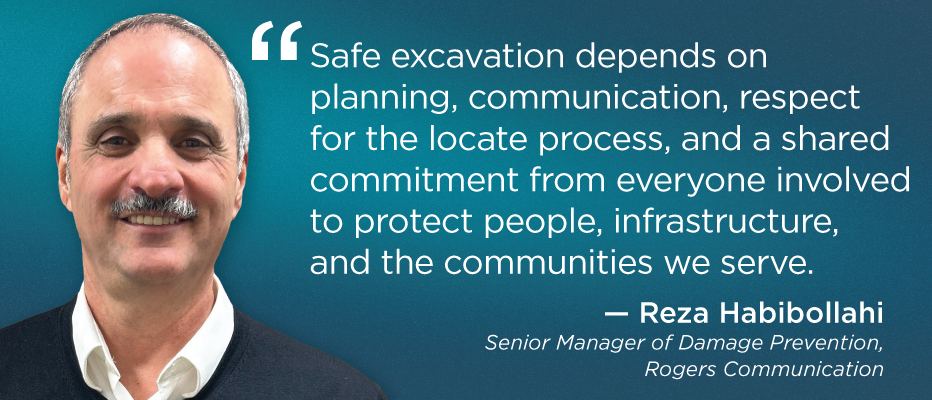
Reza Habibollahi, senior manager of Damage Prevention with Rogers Communications and a BC 1 Call Board Director, works with contractors, municipalities, other utility owners, locators and industry partners to strengthen safe excavation around communications infrastructure that communities depend on. Habibollahi believes the most effective damage prevention begins before excavation starts, when contractors obtain locates, understand site conditions and co-ordinate with infrastructure owners whenever uncertainty exists.
“When a contractor pauses work to request clarification, they have ultimately avoided unintentionally striking a gas, electrical or communications line that supports the community,” he says. “It’s a powerful reminder that damage prevention is about protecting lives, not just infrastructure.”
The infrastructure beneath our feet may be hidden from view, but the people responsible for protecting it deserve to be seen. No one featured in this article claimed to be the most important part of the damage prevention process. In fact, every conversation pointed in the opposite direction. Safe excavation depends on each person understanding where their responsibility begins and where someone else’s expertise becomes equally important. Information must be shared and questions must be asked. Their work rarely attracts attention because success leaves no dramatic story to tell. Instead, it leaves uninterrupted utility service, projects completed safely and workers returning home to their families at the end of another ordinary day.
For the people protecting British Columbia’s underground infrastructure, there is no greater achievement than that.
To read the full series in the Journal of Commerce click here.
You must be logged in to post a comment.