
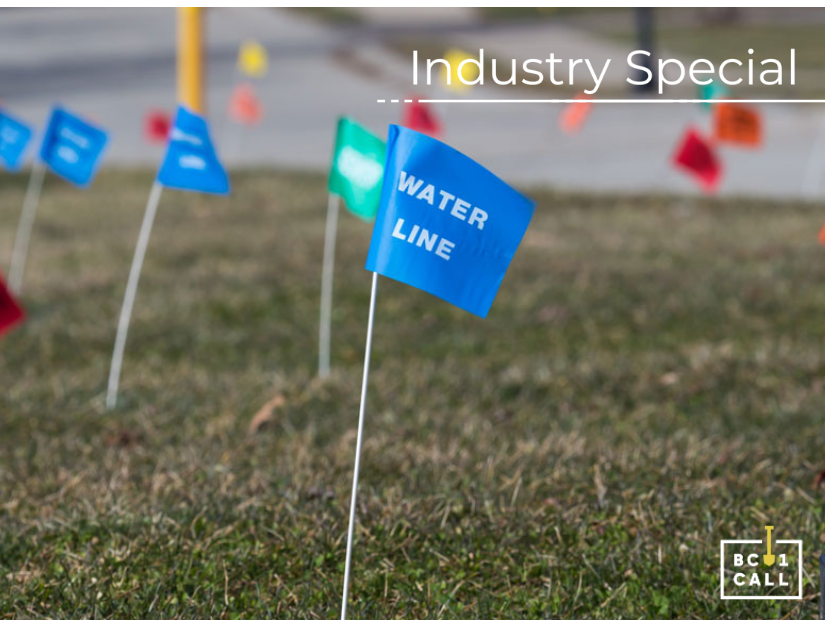
Assumptions don’t make excavation safer.
Almost every utility strike has one thing in common: someone believed they already knew what lay beneath their feet.
Whether the project involves a homeowner installing a fence, a municipality replacing a watermain or a contractor building a new hospital, safe excavation is never the result of experience alone. It comes from replacing assumptions with information, then turning that information into responsible action. Every successful excavation follows the same sequence of decisions, each one designed to reduce uncertainty before the ground is disturbed.
The damage prevention industry has long promoted the message, Click or Call BC 1 Call, and for good reason. Yet that phrase unintentionally oversimplifies what safe excavation really requires. A free locate request is not the objective. It is the beginning of a shared process involving excavators, utility owners and everyone responsible for protecting the increasingly complex infrastructure beneath B.C.
When utility strikes occur, the question is rarely whether someone had free access to information. More often, it is whether that information was requested, understood, verified and respected throughout the project.
Safety Step 1: Complete a free BC 1 Call locate request a minimum of three days before any ground disturbance activity.
This may seem obvious, yet approximately 70 per cent of reported utility strikes occur without a BC 1 Call ticket. Schedule pressure, familiarity with a site, or the belief that “it’s just a small job” continue to convince people they already know enough to proceed. Ask damage prevention professionals what they hear most often after a utility strike and the answer is remarkably consistent: “I was sure I knew where it was.”
Submitting a free BC 1 Call locate request connects excavators with participating utility owners, allowing them to identify infrastructure they own or operate within the proposed work area. It remains one of the simplest and most effective risk management practices available in construction.
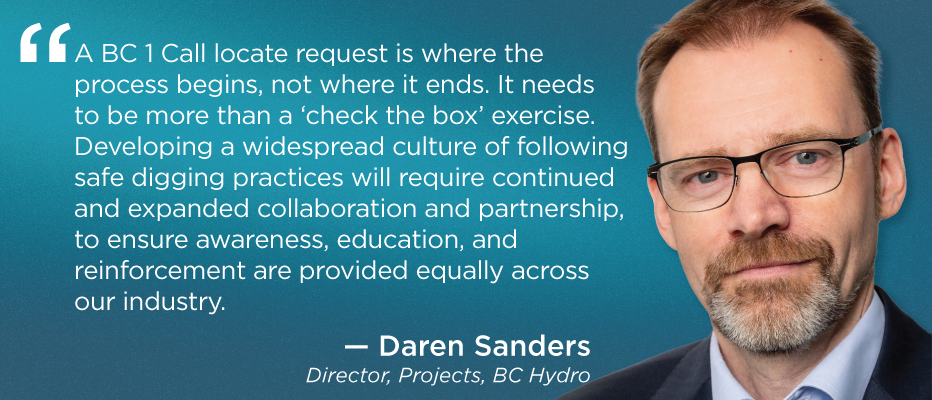
Safety Step 2: Read all the information from BC 1 Call members.
A BC 1 Call ticket is confirmation that your locate request has been processed. It is not confirmation that you are clear to excavate. Before breaking ground, carefully review every response from participating utility owners. Confirm who has responded, what infrastructure is present, what instructions have been provided and whether any additional action is required before work begins. If a notified utility owner has not yet responded, excavation should wait until they have.
Reading the responses carefully is also how excavators discover when additional authorizations are required. Work within a dedicated right-of-way containing high-pressure oil or natural gas pipelines, for example, may require permits, letters of authority, written permission or an inspector on site before excavation can proceed. Those requirements are established by the utility owner and are not replaced by a BC 1 Call ticket.
Safety Step 3: Don’t just read, understand.
Locate documentation must be interpreted correctly before work begins. Underground infrastructure records, while continually improving, are not engineering drawings. They represent the best available information, but field conditions can differ from historic records for many legitimate reasons, including decades of repairs, changes to soil conditions, relocations, abandoned infrastructure or incomplete historical documentation.
Questions are a vital part of safe excavation. Each package of information provided for free by BC 1 Call members includes contact information for additional support and clarification. Experienced excavators understand while locate information informs decisions, it can’t replace sound judgment. If you don’t fully understand, don’t dig.
Safety Step 4: Adequately and safely expose underground assets.
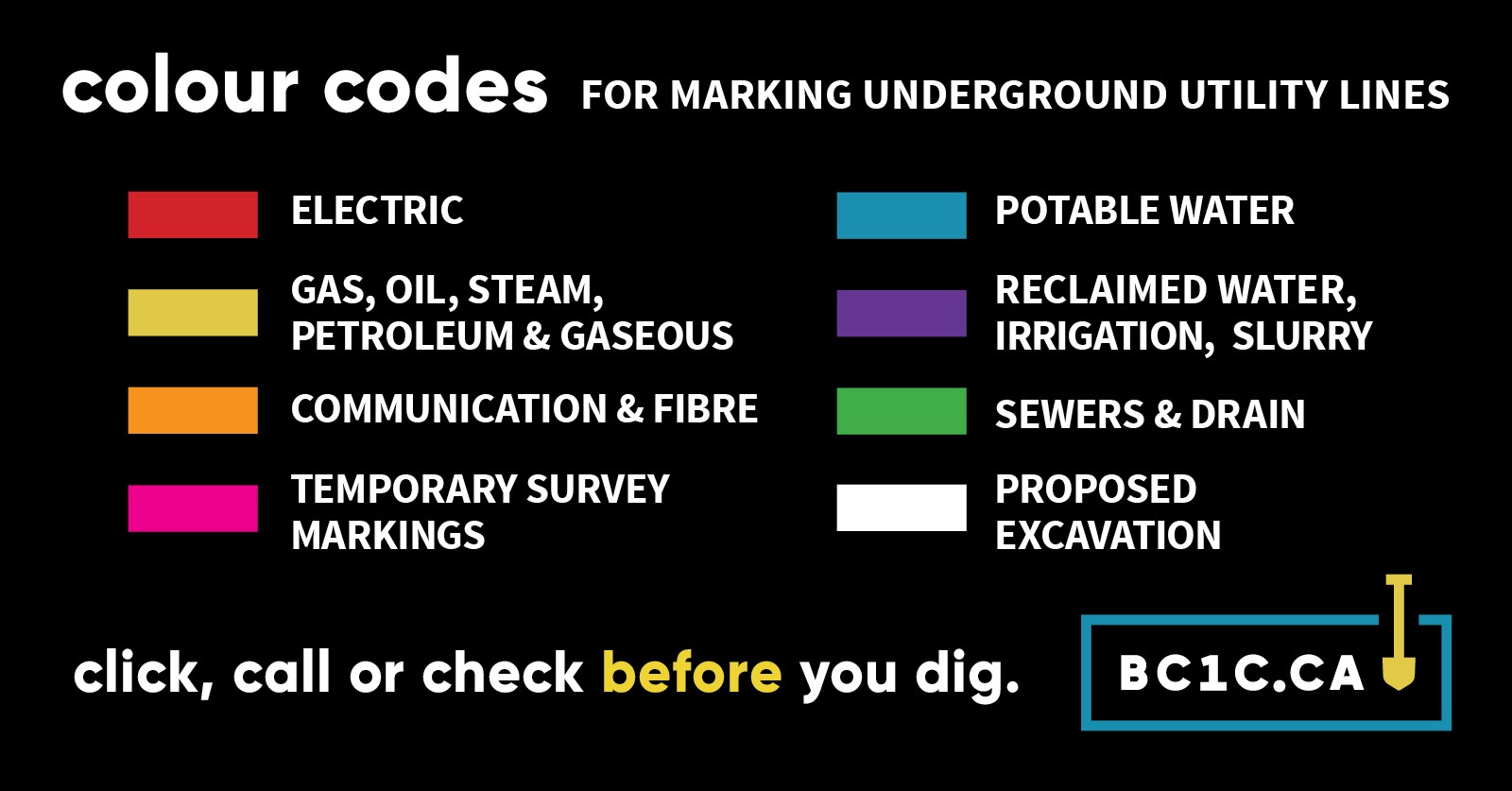
Before mechanical excavation begins near underground infrastructure, many projects rely on the expertise of trained utility locators. Using specialized locating equipment, underground records and field experience, they identify and mark the approximate location of buried infrastructure with standardized colour-coded paint and flags, translating complex underground information into markings excavators can use safely.
Those markings are an essential reference, but they are not the final answer. Standardized colours identify the type of buried utility and indicate its approximate location, but they do not confirm its exact depth, alignment or condition. Before mechanical excavation proceeds nearby, buried facilities must be safely exposed using accepted practices for hand digging, hydro-vac excavation, daylighting or potholing.
“Hand digging” is one of the most dangerously misunderstood concepts in safe excavation. It is not simply using a shovel instead of an excavator; it is a controlled process for positively identifying buried infrastructure. For distribution-pressure gas lines, the industry standard is a designated “no mechanized dig zone,” measuring a one-metre radius around the outside diameter of the pipe. Within that critical zone, mechanical excavation is strictly prohibited. The pipe must be exposed using approved non-mechanical methods.
Working from the locate markings, excavators carefully expose the utility until its exact location, depth and alignment have been positively identified. If the underground asset cannot be located where expected, stop and contact the utility owner rather than continuing based on assumptions. Always follow the specific instructions provided by the utility owner before proceeding.
Technology continues to improve how this work is performed, but the principle remains unchanged: verify what lies beneath before placing it at risk.
Safety Step 5: Protect underground assets for the duration of the project.
Everyone who breaks ground becomes a steward of the infrastructure beneath it. Exposing a utility is not the finish line; it marks the beginning of a new responsibility. For the remainder of the project, exposed pipe, conduit or cable may require temporary support and continued protection to prevent movement, sagging, damage or unnecessary stress as excavation progresses and site conditions evolve.
Damage prevention is not a single event satisfied before construction begins. It is an active responsibility that continues until excavation is complete and the ground is safely restored.
When followed consistently, these five safety steps represent one of the simplest and most effective public safety practices in B.C.’s construction industry.
Next week in Beneath B.C.
Data-driven B.C.: Finding what lies beneath. More data doesn’t always mean better information. As British Columbia’s underground information landscape continues to evolve, trusted organizations are working together to make critical geospatial data more connected, authoritative, and accessible — supporting safer excavation, better infrastructure planning and more informed decisions.
To read the full series in the Journal of Commerce click here.
You must be logged in to post a comment.