Always Click or Call Before You Clear!
Marking its third year, BC 1 Call’s Sewer Safety Awareness Week returns this fall (September 16–20, 2026) to highlight a critical yet widely overlooked hazard: gas line cross-bores.
Backed once again by founding supporters FortisBC, WorkSafe BC, BC Water & Waste Association, Public Works Association of BC, and the BC Municipal Safety Association, the campaign addresses a high-stakes safety issue hidden right beneath our feet.
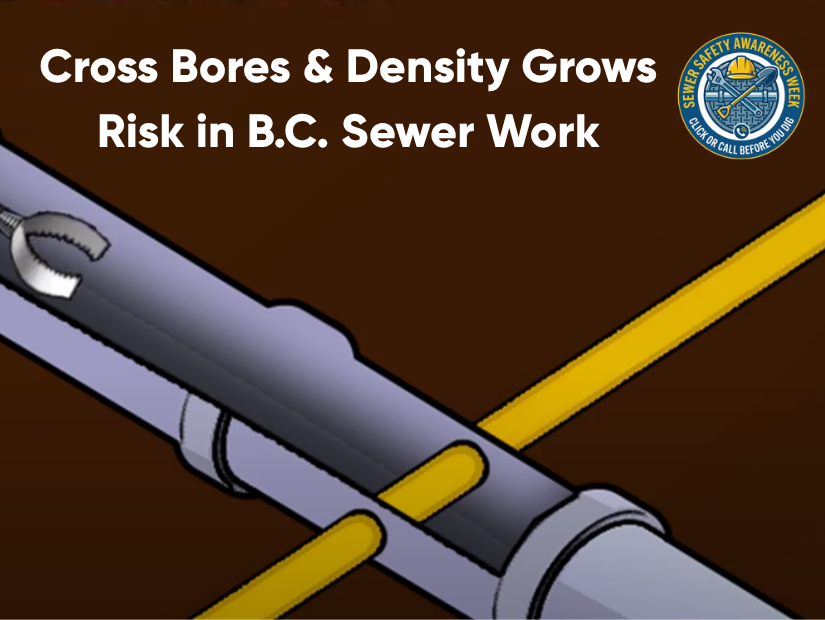
When a outdoor sewer line backs up, the instinct is to clear it immediately. However, trenchless drilling practices from years past mean natural gas lines were occasionally installed directly through existing sewer pipes. Inserting rotating equipment into a blocked pipe without checking first can rupture an unseen gas line, creating an immediate fire or explosion risk.
A short video from FortisBC breaks down:
-
How cross-bores happen: How trenchless technology accidentally routed gas lines through sewer pipes.
-
Why checking first is essential: Why contacting BC 1 Call for a free “cross-bore check” before clearing a sewer line prevents catastrophic incidents.
-
The emergency response: How FortisBC treats cross-bore check requests as priority emergencies, dispatching a technician to the site, often within two hours.
Contacting BC 1 Call before clearing a line does more than safeguard your immediate worksite—it protects the broader community. When dispatched to a site, FortisBC representatives investigate nearby areas for evidence of wider cross-bore risks. Once confirmed clear, utility records are updated to streamline future requests.
For years, FortisBC has collaborated with local governments to proactively map, identify, and relocate intersecting gas lines through a combination of mapping technologies:
-
Municipal Video Inspection: Reviewing CCTV footage captured during routine sewer maintenance in major cities to visually spot line intersections.
-
GIS Mapping Overlays: Cross-referencing digital sewer network GIS layers with FortisBC gas line data to quickly rule out non-intersecting runs.
-
Manual Paper Mapping: Comparing physical municipal record archives for smaller B.C. communities lacking digital systems.
-
Physical Inspections: Conducting on-site investigations where historical mapping data is missing or out-of-date.
“Local government collaboration and support is critical in reducing the number of cross-bore situations. This safety initiative, supported by WorkSafe BC, is a great example of everyone coming together to reduce risk of injury in a timely and open way.”
— Donna Grant, President, BC 1 Call
Tracking the Trend: Priority Ticket Volume
Despite proactive mapping efforts, legacy cross-bores still present a real hazard when sewer blockages are cleared without proper precautions. Over the last three years, while cross bore related tickets have increased which has helped improve work safety, nearly 60% of hits are caused by individuals or contractors failing to place a locate request prior to digging or clearing.
| Year | British Columbia Priority Cross-Bore Tickets Received |
| 2019 | 213 |
| 2020 | 300 |
| 2021 | 209 |
| 2022 | 136 |
| 2023 | 148 |
| 2024 | 157 |
| 2025 | 169 |
| 2026 (YTD Sept) | 84 |
Source: Data provided by BC 1 Call and FortisBC.
How You Can Support Year 3 of Sewer Safety Awareness Week
BC 1 Call and its founding supporters ask municipalities, contractors, and community members to help spread this life-saving message during Sewer Safety Awareness Week (September 16–20, 2026):
-
Share the campaign: Like, re-post, and broadcast campaign updates across your organization’s social media platforms. Click here to download our official logo.
-
Educate field crews: Bring up cross-bore risks in tailgate safety talks and crew briefings.
-
Always submit a ticket: Reinforce the requirement to log a BC 1 Call ticket for a “cross bore check” before inserting mechanized equipment into any sewer main or lateral.