

Every generation leaves something beneath our feet. The next generation must build around it.
British Columbia’s construction industry is confronting an escalating challenge: every new project is expected to create the future without disrupting the past. Beneath the ground lies infrastructure that was built years, decades and often generations ago. Much of it continues to perform exactly as intended but some of it is already past expected renewal. And perhaps most challenging of all, almost all of it must remain in service while new homes, businesses and public infrastructure are erected around it.
Construction has always been about shaping what’s next. Increasingly, success depends on understanding what came before.
Every successful project begins with the same question: What do we know about the ground below?
The quality of available information can vary enormously. It can range from century-old record drawings and hand-sketched field notes to survey-grade mapping and emerging digital twin technologies. Some infrastructure has been meticulously documented. Some has not. Every improvement in underground information reduces uncertainty, but uncertainty has not disappeared. In many ways, construction has become an exercise in managing the unknown.
Every experienced contractor has a story about discovering something that wasn’t expected underground. The best ones are the stories that end with better information, stronger records and lessons shared — not an incident.
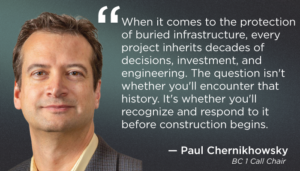
British Columbia isn’t just preparing to build. It is already building.
On July 2, Prime Minister Mark Carney and Premier David Eby announced a landmark agreement to “unlock Canada’s full potential as an energy superpower.” The Canada-British Columbia Cooperative Prosperity Agreement will accelerate construction of major energy and trade corridors throughout the province, including major underground asset expansions for the following:
- LNG Canada Phase 2, Ksi Lisims LNG, Cedar LNG and Woodfibre LNG
- Red Chris Mine expansion
- North Coast Transmission Line
- Port of Vancouver-Roberts Bank trade corridor
- George Massey Tunnel replacement project
- Port of Prince Rupert and the Port of Stewart
On the same day, Carney announced a West Coast pipeline project, referred to the Major Projects Office and transporting one million barrels per day of oil, would largely follow the existing Trans Mountain corridor across B.C.
On June 18, the two leaders also announced a 10-year partnership that will see the federal government invest more than $5 billion in B.C.’s local infrastructure through the Build Communities Strong Fund. The agreement includes a combined investment of up to $3.2 billion to expand housing-enabling infrastructure such as water systems, wastewater systems and local roads. It also includes a separate $2.5 billion federal commitment for public transit projects over the next decade. Concurrently, the province continues to advance hundreds of public and private projects through its Major Projects Inventory.
The numbers leave little doubt about where we’re headed. The question is whether our understanding of the underground is keeping pace.
Much of the infrastructure already beneath our feet wasn’t built for this moment. Statistics Canada reports nearly one in five kilometres of Canada’s buried water, wastewater and stormwater infrastructure exceeded 50 years of age in 2020. Many of those assets continue to perform exactly as intended but can they be relied upon while accommodating new development, new technologies and higher expectations for reliability?
The challenge isn’t simply expanding what’s underground. It’s integrating the future into infrastructure built in the past. Every project we complete becomes part of that legacy. Long after today’s cranes and construction fencing disappear, the infrastructure we install and the decisions we make to protect what is already there, will shape the communities that future generations inherit.
Next week in Beneath B.C.
A Province Growing Downward: Every project changes two landscapes: the one we see, and the one beneath our feet…
To read this full series on the Journal of Commerce website please click here.
You must be logged in to post a comment.